




TL;DR: Rolex serial numbers help date older watches and spot basic inconsistencies, but counterfeits now replicate them convincingly. Authentication in 2026 requires professional inspection across multiple elements, not serial number checks alone.
Quick Answer:
-
Pre-2005 watches: serial number between the lugs at 6 o'clock (bracelet removal needed)
-
2008 onwards: engraved on the rehaut, visible without bracelet removal
-
Pre-2010 serials follow patterns you can date; post-2010 are randomised
-
A genuine-looking serial does not guarantee a genuine watch
-
Professional authentication examines movement, case construction, and component consistency together
We've spent more than 20 years working with people buying and selling Rolex watches, including those searching for pre-owned Rolex watches in London who want confidence before committing.One question comes up more than almost any other: how do you check the serial number to confirm a watch is genuine?
The question matters more now than it did even five years ago. In 2026, the counterfeit watch market has reached a level of sophistication where visual inspection alone falls short. Counterfeiters now employ manufacturing processes that rival legitimate watchmakers, with cloned movements and material manipulation that reduces disparities in weight, feel, and optical properties.
Understanding what a serial number tells you, and what it doesn't, protects you in ways urgency never does.
Where to Find Your Rolex Serial Number
The location depends on when your watch was made.
For watches produced before 2005: The serial number sits between the lugs at the 6 o'clock position. You'll need to remove the bracelet to see it.
Between 2005 and 2008: Rolex transitioned the serial number location. During this period, you'll often find the number in both places: between the lugs and engraved on the inner rehaut (the ring between the dial and crystal).
From 2008 onwards: Rolex moved the serial number exclusively to the rehaut at the 6 o'clock position. You see it without removing the bracelet by angling the watch under light.
This change wasn't arbitrary. Moving the serial number made it more difficult for counterfeiters to replicate, though as we'll discuss, it didn't solve the problem entirely.
Key point: Serial location changed over time for anti-counterfeiting reasons, but counterfeiters adapted.
What a Serial Number Tells You
For watches produced before 2010, the serial number follows a pattern that lets you estimate the production year with reasonable accuracy. Rolex used different systems over the decades: numeric sequences from the 1920s through the 1980s, letter prefixes from the late 1980s onwards, and a combination that allowed dating within a year or two.
In 2010, everything changed. Rolex randomised their serial numbers. Serial number lookup tools cannot date watches produced after this point. The numbers no longer follow a standardised convention, so you cannot determine production year from the serial alone.
This matters when you're trying to verify a seller's claims about a watch's age or when assessing whether the serial matches the model's known production period.
Key point: Pre-2010 serials help date watches; post-2010 randomised serials offer no dating information.
What a Serial Number Cannot Tell You
Here's what we've learned from thousands of authentication cases: a genuine-looking serial number does not guarantee a genuine watch.
Counterfeiters replicate serial numbers. They engrave plausible numbers onto fake cases. They even copy legitimate serial numbers from genuine watches and stamp them onto counterfeits.
The scale of this problem is worth noting. According to the Swiss Customs Service, 30 to 40 million counterfeit watches enter circulation each year, roughly matching or exceeding genuine Swiss watch production. Around 10% of these fakes are so convincing they're effectively undetectable without expert inspection or manufacturer verification.
This is why serial numbers must always be assessed alongside the watch itself, not in isolation.
Key point: Counterfeiters replicate serial numbers convincingly. A matching serial format proves nothing without comprehensive authentication.
If you're unsure about authenticity, it's often safer to sell your Rolex safely in the UK through a trusted dealer who handles verification professionally.
The Super-Fake Problem
Five years ago, about 80% of counterfeit watches were easy to spot at first glance. Today, that ratio has reversed. Approximately 80% now require closer inspection to identify as fake. Weight feels right. Finishing looks correct. Movement sounds authentic. Serial numbers match known formats.
Luxury watch authenticators rejected nearly one-third of timepieces submitted for resale in 2024 because they were counterfeit, and these were watches that had already passed initial seller scrutiny.
The market has changed. What worked for authentication even three years ago isn't sufficient now.
Key point: Modern counterfeits pass visual inspection. Professional authentication with movement inspection is now essential.
How to Properly Authenticate a Rolex
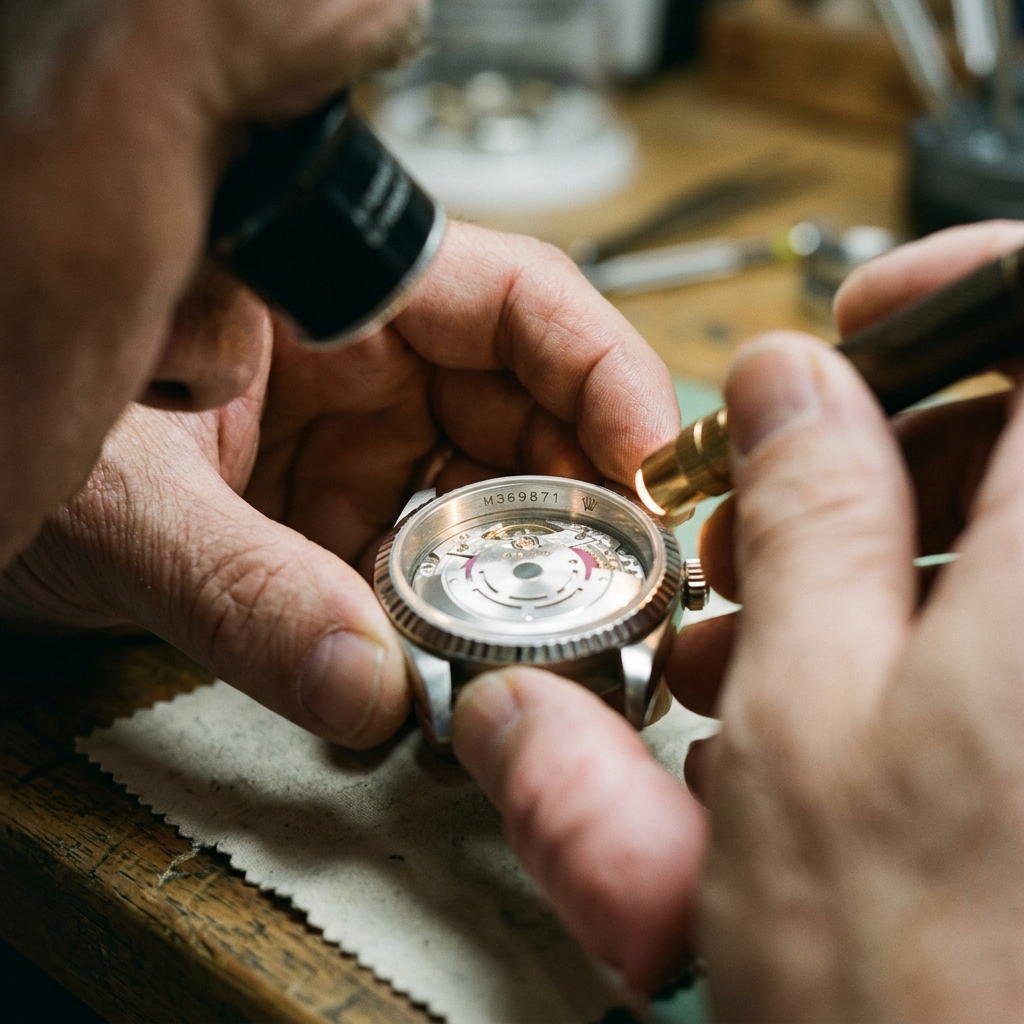
Checking the serial number is one step in a larger process. Authentication requires examining multiple elements together: case construction and finishing (how the metal feels, how edges are finished, how components fit together), dial details (printing quality, lume application, spacing and alignment), movement inspection (this requires opening the case back, something only trained professionals should do), bracelet and clasp (construction quality, stamping, how links articulate), and serial and reference number correlation (do they match the model and production period?).
No single element proves authenticity. You're looking for consistency across all of them.
Professional Authentication
Only Rolex definitively confirms a watch's authenticity. Through their Certified Pre-Owned programme, watches are fully disassembled and each component, from case and bracelet to movement, is meticulously checked and authenticated.
You also have a watch authenticated at a Rolex Service Centre for approximately £120. You pay the fee, a professional authenticates on-site, and Service Authentication Papers arrive within 7 to 10 days.
This level of verification protects value long after the sale. It also gives you documentation that supports resale and insurance claims.
Key point: Rolex Service Centres provide definitive authentication for £120 with documentation in 7 to 10 days.
Red Flags When Checking Serial Numbers
Over the years, we've noticed patterns that signal problems.
Engraving quality that doesn't match Rolex standards: Rolex engraving is precise, evenly spaced, and consistent in depth. Poor engraving (shallow, uneven, or crudely executed) is often the first visible sign of a counterfeit.
Serial numbers that don't match the model's production period: If a seller claims a watch is from 2015 but the serial format matches 2008, something is wrong.
Reluctance to provide clear photographs of the serial number: Legitimate sellers understand buyers need to verify details. Evasiveness is a warning sign.
Pressure to complete the transaction quickly: Rushing reduces your ability to verify properly. Legitimate dealers give you time to check everything thoroughly.
Key point: Poor engraving, mismatched production periods, evasiveness, and pressure to rush are reliable warning signs.
Why Working With Established Dealers Matters
We don't say this to push a sale. We say it because we've seen what happens when authentication is treated as optional.
Established dealers absorb the authentication risk on your behalf. We inspect every watch that comes through, not just visually, but through hands-on examination that includes opening the case back, checking movement authenticity, and verifying component consistency. When something doesn't feel right, we walk away from the deal. That protects you from inheriting a problem we spotted too late.
You also gain access to proper documentation, transparent history, and aftercare that extends beyond the sale. Repairs, servicing, and long-term guidance become part of the relationship, not an afterthought.
This is especially important in 2026, where the counterfeit market has become sophisticated enough that even experienced private buyers get caught out.
Key point: Established dealers absorb authentication risk through professional inspection and provide documentation and aftercare as part of the relationship.
What to Do Before You Buy
If you're considering a Rolex purchase, whether from a dealer, platform, or private seller, take these steps.
Ask for clear photographs of the serial number, reference number, and case back: Legitimate sellers provide these without hesitation.
Verify the serial format matches the claimed production period: For pre-2010 watches, cross-reference the serial against known dating charts. For post-2010 watches, confirm the format is consistent with randomised serials.
Request documentation: Original papers, service history, and purchase receipts all add credibility.
Arrange independent authentication if buying privately: The cost of professional verification is negligible compared to the risk of buying a counterfeit.
Don't rush: Pressure to decide quickly often signals a problem. Legitimate transactions wait while you verify properly.
Key point: Request photos, verify serial formats, ask for documentation, arrange independent authentication, and take your time.
Frequently Asked Questions
Where is the serial number on a Rolex?
Pre-2005 watches have the serial number between the lugs at 6 o'clock, requiring bracelet removal. From 2008 onwards, the serial sits on the rehaut (inner bezel ring) at 6 o'clock, visible without bracelet removal. Between 2005 and 2008, you'll often find it in both locations.
Does the serial number prove a Rolex is real?
No. Counterfeiters replicate serial numbers convincingly, copying formats and even legitimate numbers from genuine watches. A plausible serial number is one data point, not proof of authenticity. Professional authentication examining movement, case construction, and component consistency is essential.
How do you date a Rolex from the serial number?
Pre-2010 watches follow dating patterns (numeric sequences, then letter prefixes) that let you estimate production year within a year or two. Post-2010 watches use randomised serials that provide no dating information. You'll need to rely on other identifiers and documentation for newer watches.
What does a Rolex serial number look like?
Pre-2010 serials follow patterns: numeric sequences (1920s through 1980s) or letter prefixes (late 1980s to 2010). Post-2010 serials are randomised alphanumeric strings with no discernible pattern. All genuine Rolex serials feature precise, evenly spaced, consistently deep engraving.
How much does professional Rolex authentication cost?
Rolex Service Centres authenticate watches for approximately £120. You receive on-site professional authentication and Service Authentication Papers within 7 to 10 days. This provides manufacturer-verified documentation that supports resale and insurance claims.
What are the warning signs of a fake Rolex serial number?
Poor engraving quality (shallow, uneven, crudely executed), serial formats that don't match the claimed production period, reluctance from sellers to provide clear photographs, and pressure to complete transactions quickly all signal problems worth investigating further.
Should you buy a Rolex without papers?
Watches without original papers carry higher authentication risk, though legitimate reasons exist for missing documentation (lost over time, purchased pre-owned without papers). Professional authentication becomes even more important. Established dealers authenticate thoroughly regardless of documentation and provide their own guarantees.
Where do super-fakes come from?
Modern counterfeits originate from sophisticated manufacturing operations using cloned movements and material manipulation that mimics genuine watches in weight, feel, and appearance. The Swiss Customs Service reports 30 to 40 million counterfeit watches enter circulation annually, with around 10% sophisticated enough to require expert inspection to identify.
Key Takeaways
-
Serial numbers help date pre-2010 watches and spot format inconsistencies, but they don't authenticate watches on their own
-
Counterfeiters replicate serial numbers convincingly, copying formats and legitimate numbers from genuine watches
-
Professional authentication examines movement, case construction, dial details, and component consistency together
-
Rolex Service Centres provide definitive authentication for £120 with documentation in 7 to 10 days
-
Red flags include poor engraving, mismatched production periods, seller evasiveness, and pressure to rush
-
The counterfeit market has grown sophisticated enough that visual inspection alone falls short in 2026
-
Established dealers absorb authentication risk through professional inspection and provide documentation and aftercare
Serial numbers are one piece of the authentication puzzle, not the whole picture. They help you date older watches, cross-reference production periods, and spot obvious inconsistencies. But they don't authenticate a watch on their own, not in 2026, where counterfeiting has become an industrial operation producing millions of convincing fakes each year.
Proper authentication requires experience, time, and access to the watch itself. It means examining details that aren't visible in photographs and checking consistency across multiple elements. That's why slowing down protects you better than rushing ever does.
Does the process feel more involved than you expected?