




In 1931 Rolex managed to patent a self-winding watch movement. This was very special at the time as this was one of the very first movements to be wound through a rotor “weight” . This means that the weight moved when the wearer of the watch moved their arm and wrist, and this kept perpetually winding the mechanism. Hence the name, perpetual.
The first Perpetual movements were not exclusively designed and produced by Rolex. Originally they were modules that consisted of rotor assembly mechanisms that could be bolted onto the back of an existing movement, called the Hunter from movement maker Aegler. Adding a module onto a pre-existing movement meant an even thicker movement which needed even more space in a watch case. To fit into the then new feature case, the Oyster, it needed to be even more spacious with a deeper caseback.
The first Oyster Perpetual model was released in 1950. There were a couple of various calibres used such as the 645 and 1030, which was also featured inside the early Submariner and the Explorer.
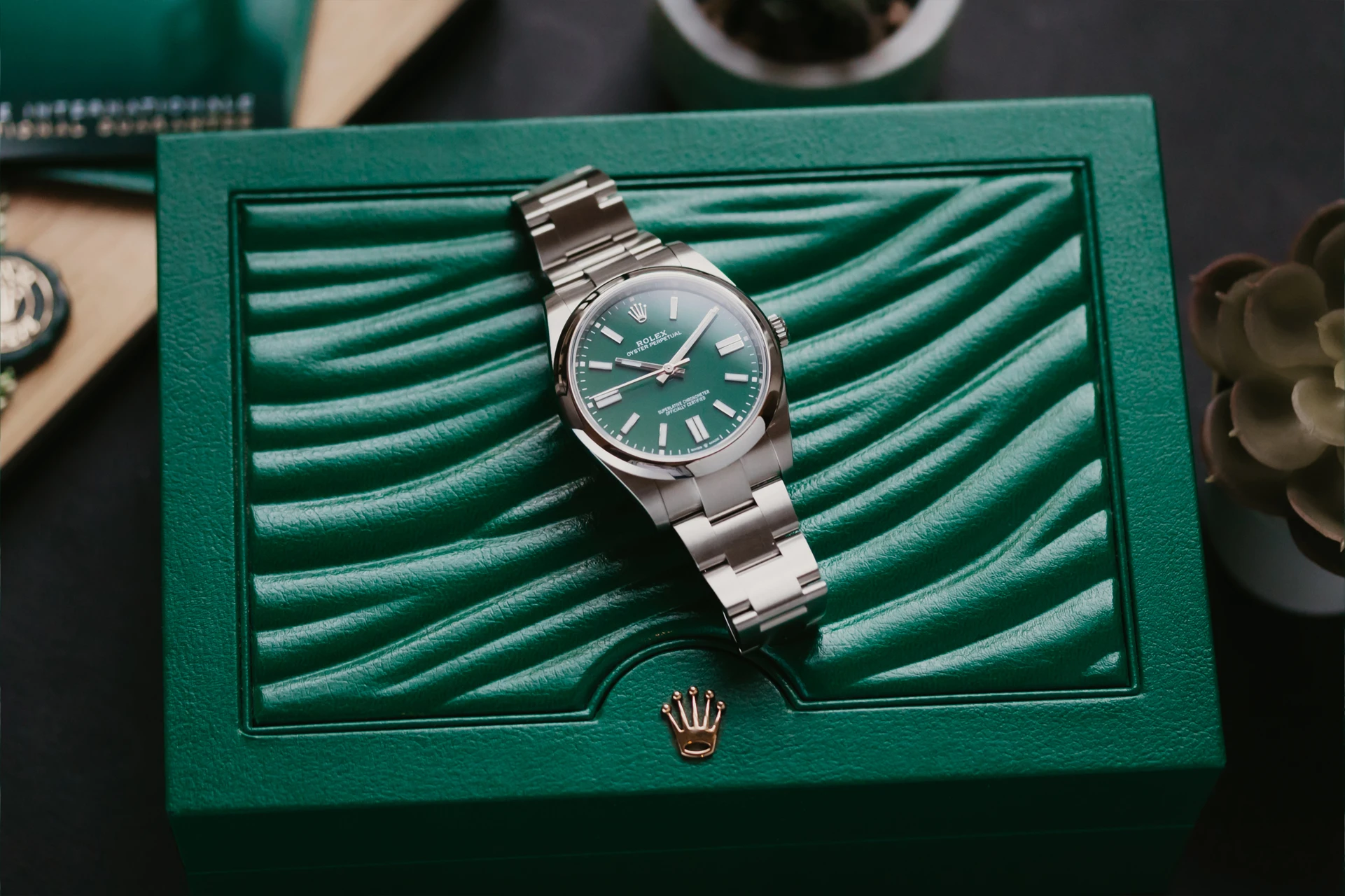
From 1959 onwards the Rolex Oyster Perpetual No-Date featured automatic movements. This particular model was always 36mm in size, it featured a plastic crystal and a 26 jewels movement. At the time a selection of bracelets were available in stainless steel, steel and gold with yellow, white, pink gold bezel. You could even purchase the whole watch in solid pink or yellow gold. The two calibres that feature within this generation of Oyster Perpetual are the 1560 and the 1570. The production for this Oyster Perpetual ended in the 1980s.
In 1964 the first Ladies Oyster Perpetual was released it featured a 26 jewel calibre 1130, all with plastic crystals, a small case at 24.6mm diameter and was available with oyster or jubilee bracelets.In 1974 the Ladies Oyster Perpetual was upgraded to the new calibre 2030. This time it featured 28 jewels and it saw one of the first introductions of the Hack function. In 1998 the ladies Oyster perpetual was available with a new calibre 2135. This was the first time the Ladies Oyster Perpetual increased its size from 24.6 to 25.9 almost a mid-size. These new calibres now have 29 jewels but to the owners the biggest difference was the inclusion of sapphire crystal.

The new iteration the reference 76080 saw another change in size, this time slightly smaller to 25mm. The new calibre inside the 2235 now has 31 jewels, other than this and the general updates on all the bracelets everything is the same.
Midsize was made from 1960 till 1986 and then 1987 till 2014.
2014 the new Oyster Perpetual was available in 4 different sizes, 26mm, 31mm, 34mm and 36mm. And in 2015 Rolex added yet another size to the Oyster Perpetual line, a 39mm option, making the new Oyster Perpetual proposition the most flexible in comparison to any of the other Rolex models.

According to its size, the Oyster Perpetual is equipped with either calibre 3132 (39 mm version), 3130 (36 and 34 mm versions), or 2231 (31 and 26 mm versions), three self-winding mechanical movements completely developed and manufactured by Rolex. Each of the movements are certified Swiss chronometers, which means they are incredibly precise.
In calibres 3132 and 3130, the oscillator has a blue Parachrom hairspring patented and manufactured by Rolex in an exclusive alloy of niobium and zirconium. The Parachrom hairspring offers great stability in the face of temperature variations and remains up to 10 times more precise than a traditional hairspring in case of shocks as well as having anti-magnetic properties.
As you can see the Oyster Perpetual offers a lot of different options when it comes to size and design, which one would you choose?
Visit us in store for great service and to see our amazing collection.
114 Ballards Lane, N3 2DN, London 020 8838 3655