
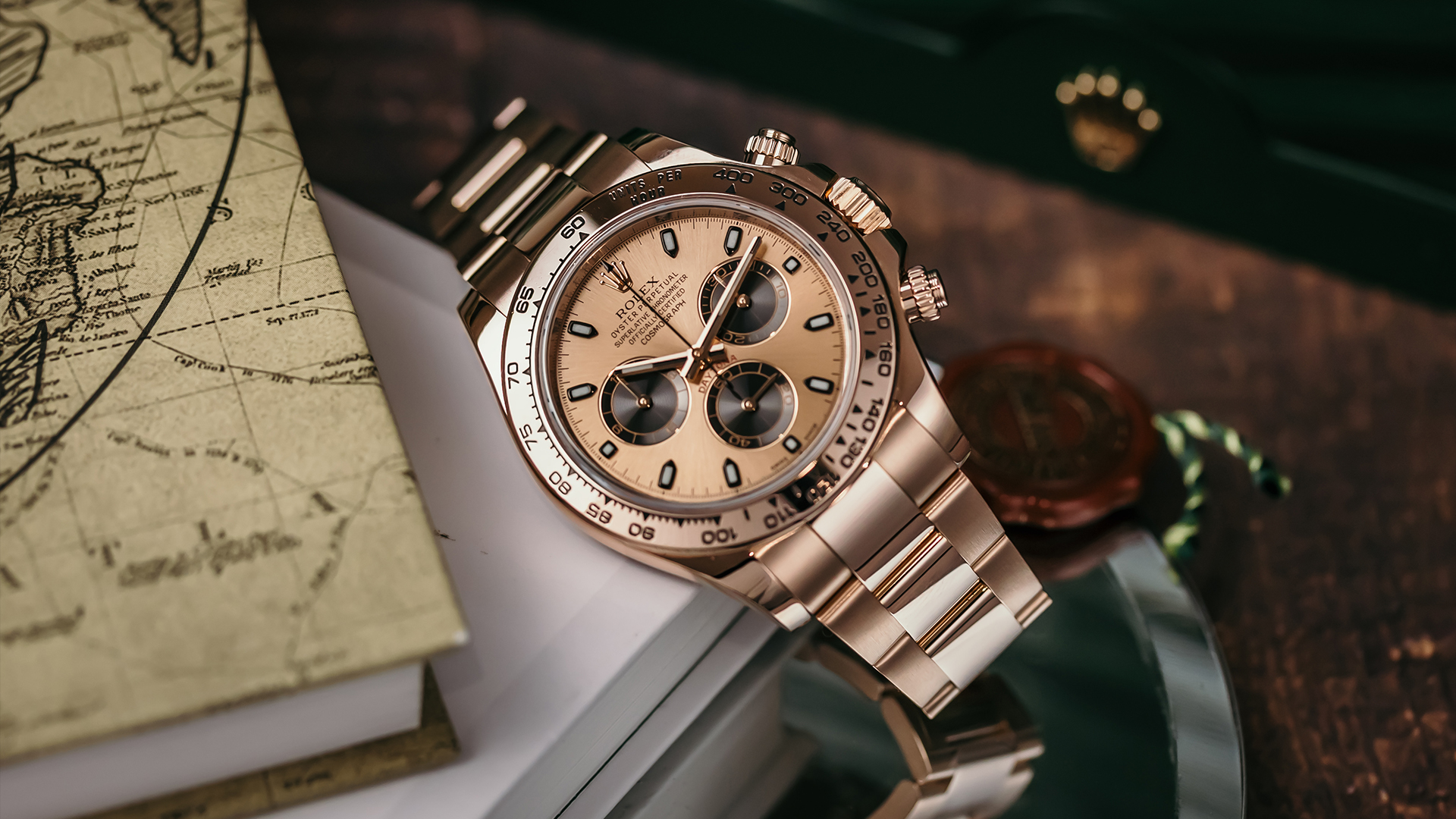





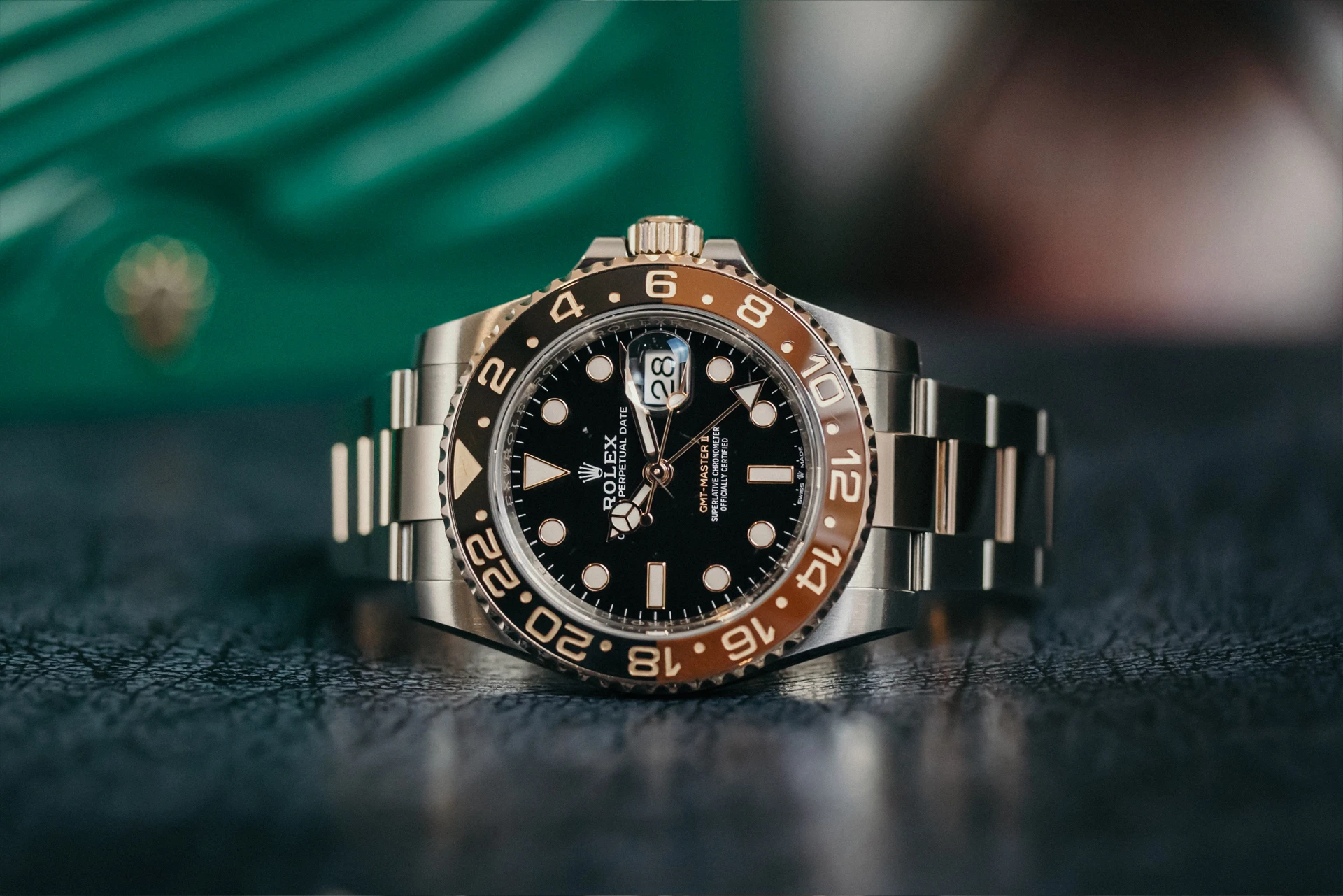
To find out more about the history of this incredible Rolex watch let’s take a little trip back in time. At the International Meridian Conference in Washington D.C. in 1884, the world was officially divided into 24 time zones, and the Greenwich Meridian came to be internationally recognised as the site of Greenwich Meantime.
In the 1930s, a genius horologist Louis Cottier had created a wristwatch-sized version of the world time mechanism that showed the correct time in 24 different zones simultaneously. Even though this was incredible, not many people needed to know 24 time zones at once. You might expect that someone else would soon devise a simpler version of this mechanism to cater for the people who only really cared about the time in two places. And of course, this someone was Rolex.
Rolex was approached by the Pan- American Airlines during the preparations for the first intercontinental jet passenger flights. Most people these days are familiar with jet lag but, back in the ‘50s, a method of combating it was still being sought – especially since pilots seemed no less prone to its effects than passengers. So prior to putting the new jet into full service, Pan Am asked Rolex to develop a wristwatch that would let its wearer tell the time at a glance in both the ‘home’ and ‘destination’ time zones, partly in the slightly naive belief that being able to see both times simultaneously would trick the mind into not noticing the hours that had been lost or gained.
Rolex worked with several of the airline’s most experienced pilots, and created the GMT-Master, featuring a version of the rotatable bezel first seen on a production Rolex in the Turn-O-Graph of the previous year. In the case of the GMT-Master, however, the bezel was calibrated into 24 hours and designed to be used in conjunction with a fourth hand – the 24-hour hand – which was coloured red to make it instantly identifiable.
The rotatable bezel was made from steel with a Plexiglass insert, one half of which was coloured blue to represent night and the other half red to represent day. It was very simple to set the 24-hour hand so that it showed the time at destination on the bezel, leaving the main hour hand on the wearers ‘home’ time. The GMT Master was originally designed for pilots but its combination of functionality and good looks led to it being adopted by an increasingly well-travelled public.
The original model colors that feature the red and blue on the bezel often get called by the nickname “Pepsi”.
In the early 1980s the Rolex GMT-Master II was released. Want to know more about it? Click here!