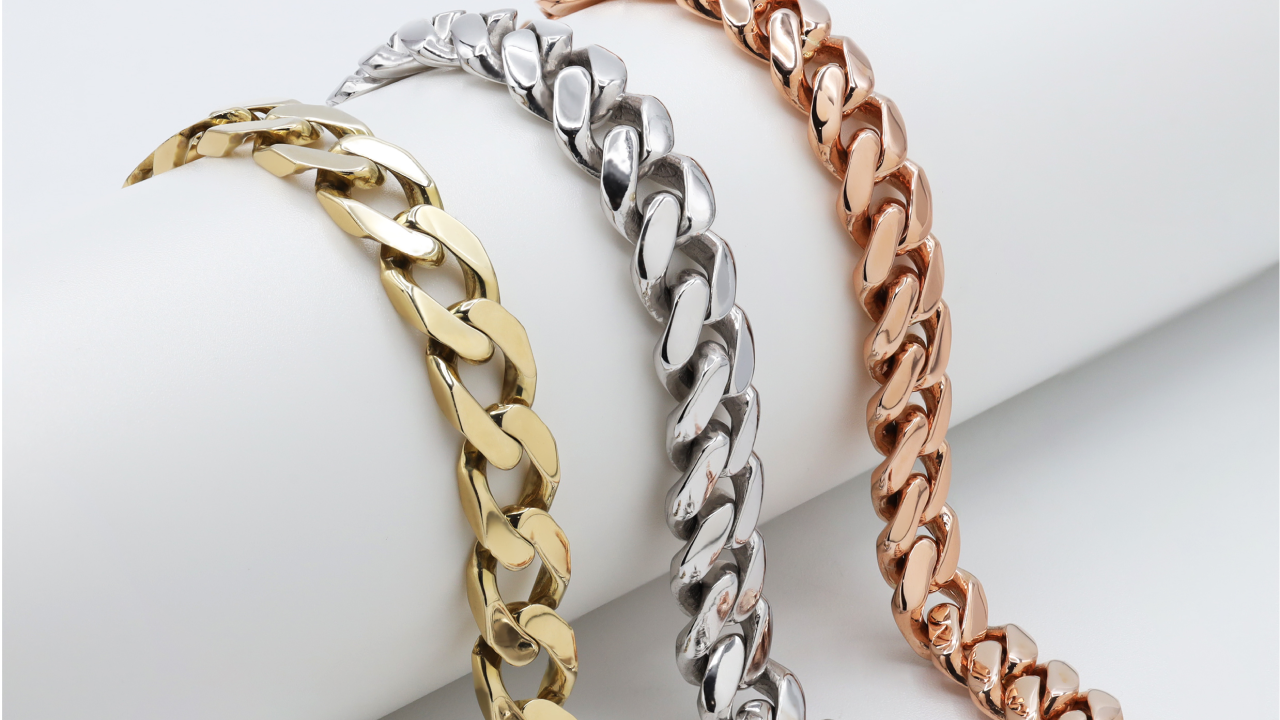





Quick Answer: Rolex bracelet types include six main styles. The Oyster (three-link sports bracelet), Jubilee (five-link dress-sport), President (semi-circular luxury), Oysterflex (elastomer with metal blades), Pearlmaster (gem-set), and leather straps (vintage only). Your choice affects comfort, durability, resale value, and which models you're able to buy.
Oyster bracelets resist stretch better and suit daily wear on sports models
Jubilee bracelets offer more flexibility and comfort but stretch over time
President bracelets come only in precious metals, exclusive to Day-Date
Bracelet choice affects resale value by up to 40% if replaced with aftermarket parts
All Rolex bracelets use Oystersteel (904L steel), gold, platinum, or titanium
Your bracelet choice influences more than appearance. We've watched people spend weeks comparing dial colours, then treat the bracelet like an add-on. The bracelet shapes how the watch feels during daily wear, how well it holds value, and which models you're able to choose.
Rolex manufactures bracelets from Oystersteel (904L stainless steel), gold, platinum, or titanium. The brand builds proprietary clasp systems into each type: Oysterclasp, Crownclasp, Glidelock extension (up to 20mm adjustment), and Easylink comfort extension (5mm quick adjustment). These systems improve fit when your wrist changes size throughout the day.
When people ask "what are the different types of Rolex bracelets", the answer covers six distinct bracelet styles. Each serves specific models and wearing situations.
Oyster bracelet: Classic three-link sports bracelet
Jubilee bracelet: Five-link dress-sport style from 1945
President bracelet: Semi-circular design exclusive to Day-Date
Oysterflex bracelet: Elastomer strap with internal metal blades
Pearlmaster bracelet: Rounded five-link design for gem-set models
Leather straps: Found on vintage references only
What this means for you: Understanding all types of Rolex bracelets clarifies which models you're able to choose and what trade-offs you're making in comfort, durability, and long-term value. The cost of a Rolex varies significantly depending on bracelet type, with precious metal bracelets adding thousands to the overall price.
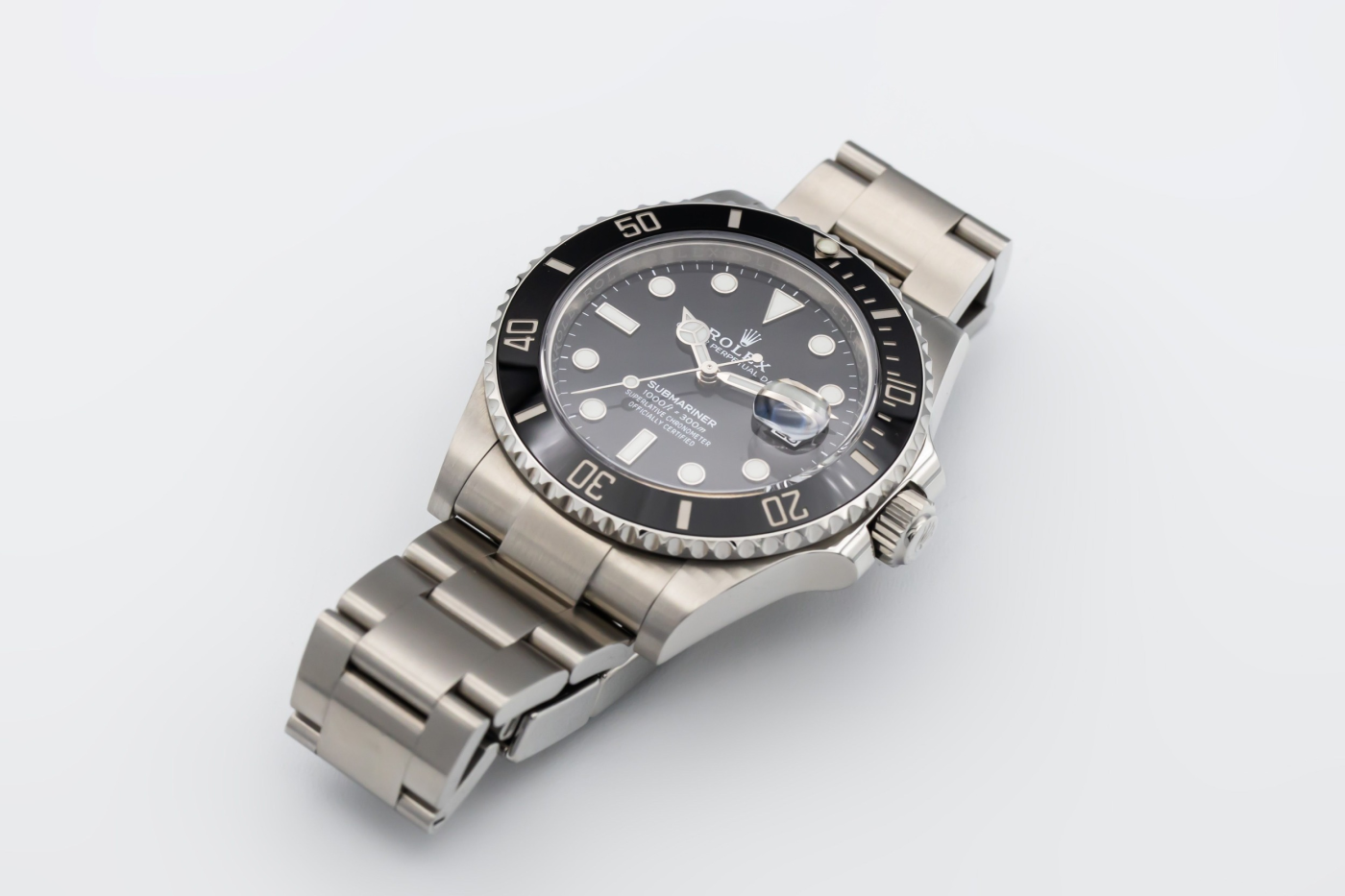
The Oyster bracelet appeared in the late 1930s. It's now the most common Rolex bracelet, fitted to most sports models by default.
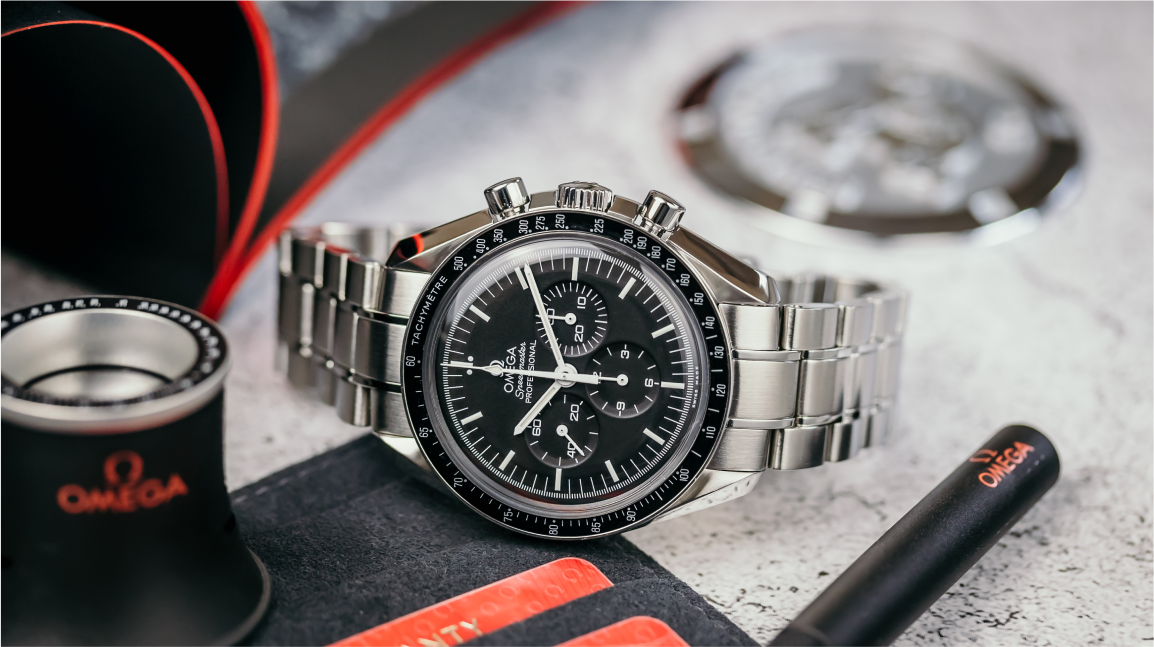
Three-piece flat-link construction gives the Oyster its structure. Each section contains three broad links (one centre, two outer). Fewer connection points mean the bracelet holds its shape better than multi-link designs.
Steel versions use Oystersteel, Rolex's 904L stainless steel alloy. This resists corrosion better than the 316L steel you'll find in most watches. Precious metal Oyster bracelets come in 18k gold or 950 platinum. Two-tone Rolesor versions combine steel with gold.
Brushed surfaces dominate the finish. This makes scratches less visible and gives the bracelet a sportier look. The brushed treatment helps the Oyster age well compared to polished bracelets.
Modern versions include Glidelock (20mm micro-adjustment, no tools needed) and Easylink (5mm quick extension). Both systems help when your wrist swells during the day or after exercise. These comfort features are available across different purchasing options, including Rolex finance programmes for those spreading the investment.
You'll find the Oyster on:
Submariner
GMT-Master II
Explorer and Explorer II
Daytona
Sea-Dweller and Deepsea
Milgauss
Air-King
Over two decades, we've seen collectors return to this Rolex stylefor specific reasons.
Versatile appearance: Works with casual and formal clothing
Scratch resistance: Brushed finish hides surface marks
Daily comfort: Structured fit distributes weight evenly
Resale demand: Most sought-after bracelet on sports models
Style flexibility: Neutral design suits different wardrobes
Bottom line: Fewer connection points resist stretch better. An Oyster bracelet worn daily for five years typically stays tighter than a Jubilee in similar conditions.
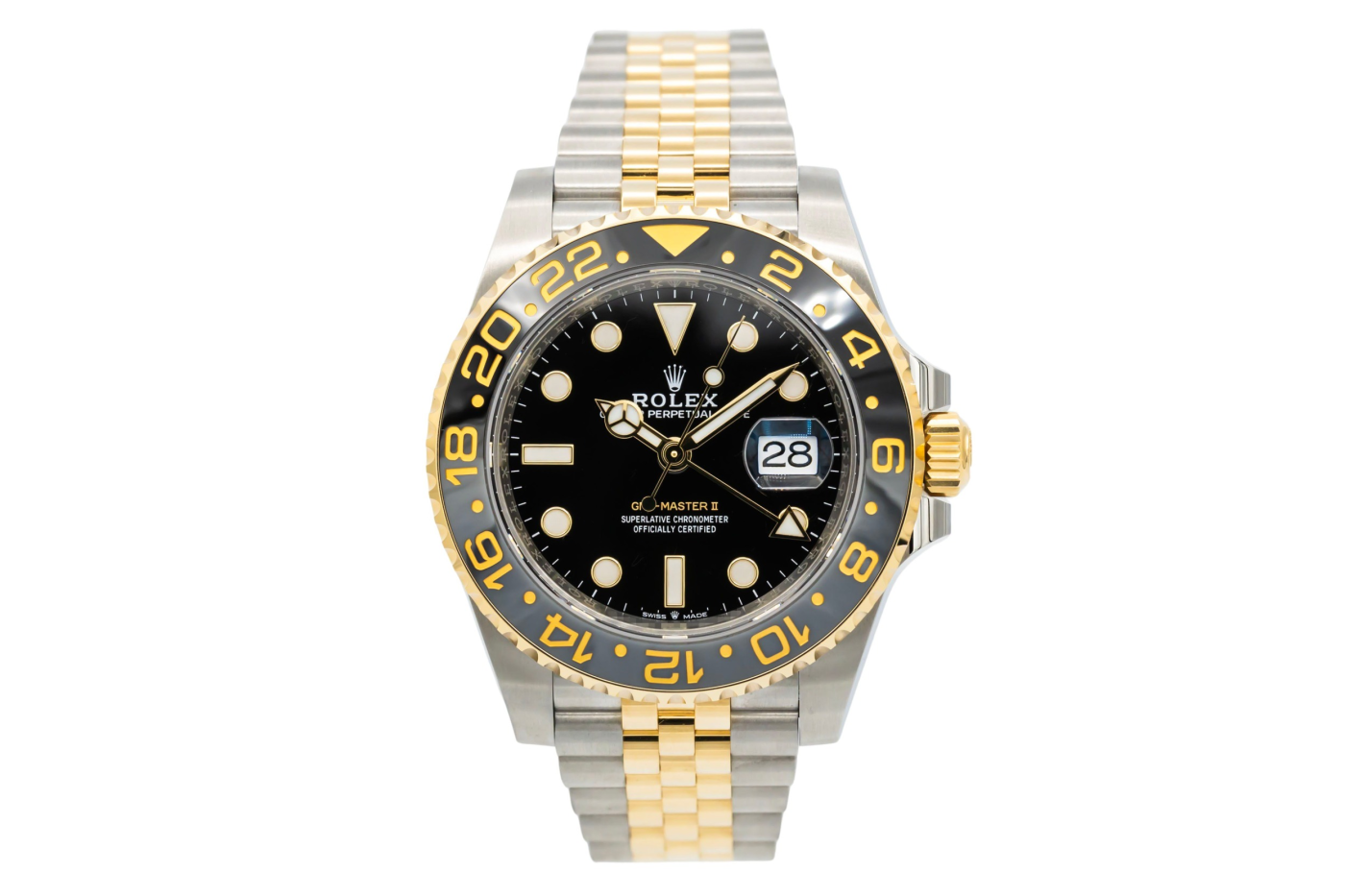
Rolex introduced the Jubilee in 1945 for the Datejust (celebrating the brand's 40th year). At launch, you'd only find it in solid gold.
Five-piece link construction creates the Jubilee's flexibility. Each section contains five links; one centre, two pairs of outer links arranged in semi-circular pattern. This gives more movement than the Oyster's rigid structure.
The five-link design drapes over your wrist instead of sitting flat. This makes it comfortable for smaller wrists and people who find rigid bracelets uncomfortable. The Jubilee flexes with wrist movement, reducing pressure points. It's worth noting: Rolex watch sizes also influence bracelet comfort, with smaller cases typically working better with the Jubilee's flexibility.
Modern versions are stronger than vintage Jubilee bracelets. Rolex strengthened links and improved pin systems over the years. This reduces, though doesn't eliminate, the tendency to stretch with wear.
Available on these Rolex models:
Datejust (all sizes)
GMT-Master II
Some Sky-Dweller references
Certain vintage Rolex models
Materials include Oystersteel, 18ct gold, two-tone Rolesor, and platinum. Most modern Jubilee bracelets use Oysterclasp or concealed Crownclasp.
Years of handling these bracelets across different references showed us consistent patterns.
More flexible than Oyster: Five-piece links conform to wrist movement
Dressier look: Refined links and flowing structure feel more formal
Light reflection: Polished centre links catch light for elegant appearance
Comfort on smaller wrists: Flexibility reduces rigid feel
Datejust classic pairing: Preferred choice for buyers wanting elegance over sport
What to expect: Five-piece construction creates more connection points than Oyster. With regular wear, looseness appears after five to ten years, especially without servicing. This isn't poor quality. It's how the design works. Regular Rolex servicing includes link tightening, which restores most of the original fit.
Choosing between the Oyster and Jubilee bracelet isn't simply about appearance. Both offer different wearing experiences depending on your lifestyle, wrist size and personal preference.
|
Factor |
Oyster |
Jubilee |
|
Wrist feel |
More structured |
More flexible |
|
Daily wear |
Better for durability |
Better for comfort |
|
Scratch visibility |
Brushed links hide marks better |
Polished links show more shine and marks |
|
Small wrists |
Can feel firmer |
Drapes more naturally |
|
Best for |
Sports models and daily wear |
Datejust, GMT-Master II, dress-sport use |
The President appeared in 1956 with the Day-Date. From launch, Rolex positioned it as their most prestigious bracelet as it's featured on the Day-Date, comes in precious metals only and never offered elsewhere.
The name came from US presidents photographed wearing Day-Dates, Lyndon B. Johnson most notably and the association stuck. The President bracelet became linked with power and prestige.
Semi-circular three-piece link design creates the President's structure. Three rounded links flow into each other, giving softer appearance than the Oyster whilst keeping three-piece construction strength.
Only available in precious metals:
18ct yellow gold
18ct white gold
18ct Everose gold
950 platinum
This exclusivity is deliberate. The President stays reserved for the Day-Date. This makes it central to what defines Rolex's flagship dressy model.
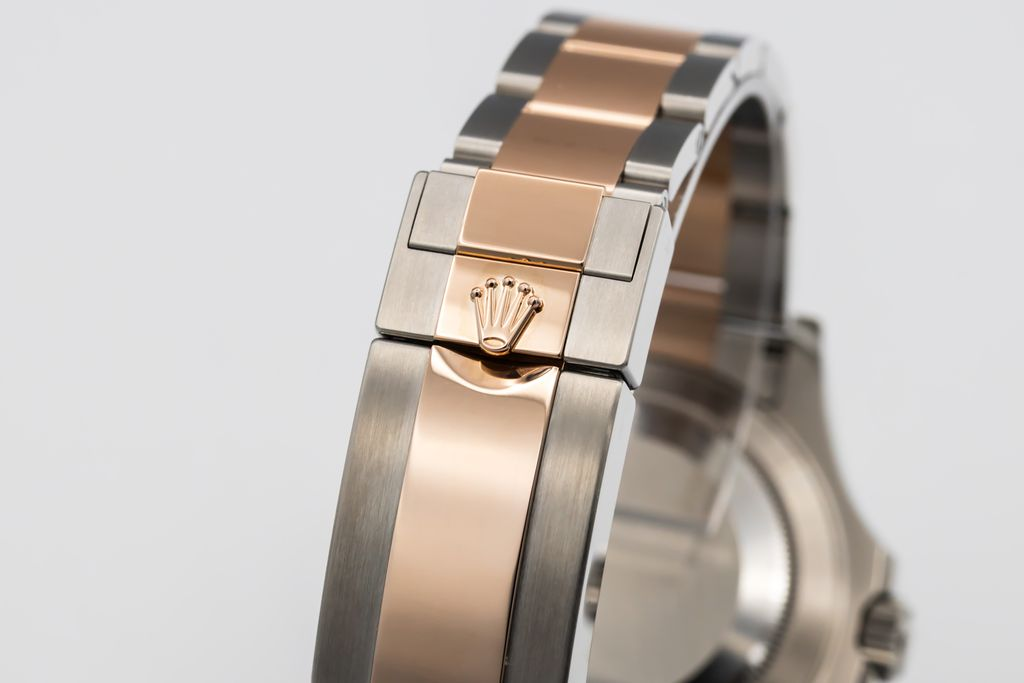
Modern President bracelets use the concealed Crownclasp. This integrates into the bracelet design more smoothly than the Oysterclasp, reinforcing the formal positioning.
Handling Day-Date references over the years showed what makes this bracelet distinct.
High-end exclusivity: Only on Day-Date models
Elegant appearance: Semi-circular links create refined aesthetic
Prestige association: "President" name carries weight and recognition
Intrinsic metal value: Gold or platinum holds significant value
Rolex's luxury peak: Represents pinnacle of materials and exclusivity
Weight consideration: This bracelet is heavier than Oyster and Jubilee. Some find this substantial and reassuring. Others find it cumbersome for all-day wear. Worth trying a Day-Date in person before committing to platinum.
Beyond the three main metal bracelets, Rolex introduced modern alternatives for specific models and purposes.
Oysterflex launched in 2015 as Rolex's rubber strap alternative. But it's not traditional rubber. Internal flexible titanium and nickel alloy metal blades sit inside, covered with high-performance black elastomer.
This gives rubber comfort and flexibility whilst maintaining Rolex bracelet durability. The metal blades prevent stretching or deforming which can be common problems with standard rubber straps.
A cushioning system sits underneath the strap for extended wear comfort. Found mainly on:
Yacht-Master (40mm and 42mm)
Daytona precious metal models
Sky-Dweller references
Uses Oysterclasp with Easylink comfort extension. Oysterflex represents Rolex's response to modern sporty aesthetics whilst maintaining their durability standards. If you're interested in trying different bracelet styles on current Rolex watches in the UK, handling them in person reveals differences no description captures.
Rounded five-piece links designed for luxury gem-set Rolex models. Heavily polished, often with diamonds or precious stones in the bracelet itself.
Reserved for high-jewellery references, which are models where the bracelet functions as jewellery equal to the watch case, you won't find Pearlmaster on sports or standard dress watches.
Rolex phased out leather straps in modern collections. Still found on vintage references and certain Cellini models. More common in earlier decades on dress watches, but metal bracelets became standard across most lines.
Rolex introduced comfort and durability upgrades across bracelet types in recent years:
Oysterflex cushioning: Reduces pressure points, improves all-day comfort
Easylink extension: 5mm quick adjustment without tools
Glidelock micro-adjustment: Up to 20mm precise fit in 2mm steps
Clasp security: Stronger closing mechanisms resist accidental opening
Corrosion resistance: Oystersteel and improved sealing protect from saltwater and environmental wear
Practical impact: These upgrades make modern Rolex bracelets more usable for daily wear than vintage versions, even when basic design stays unchanged.
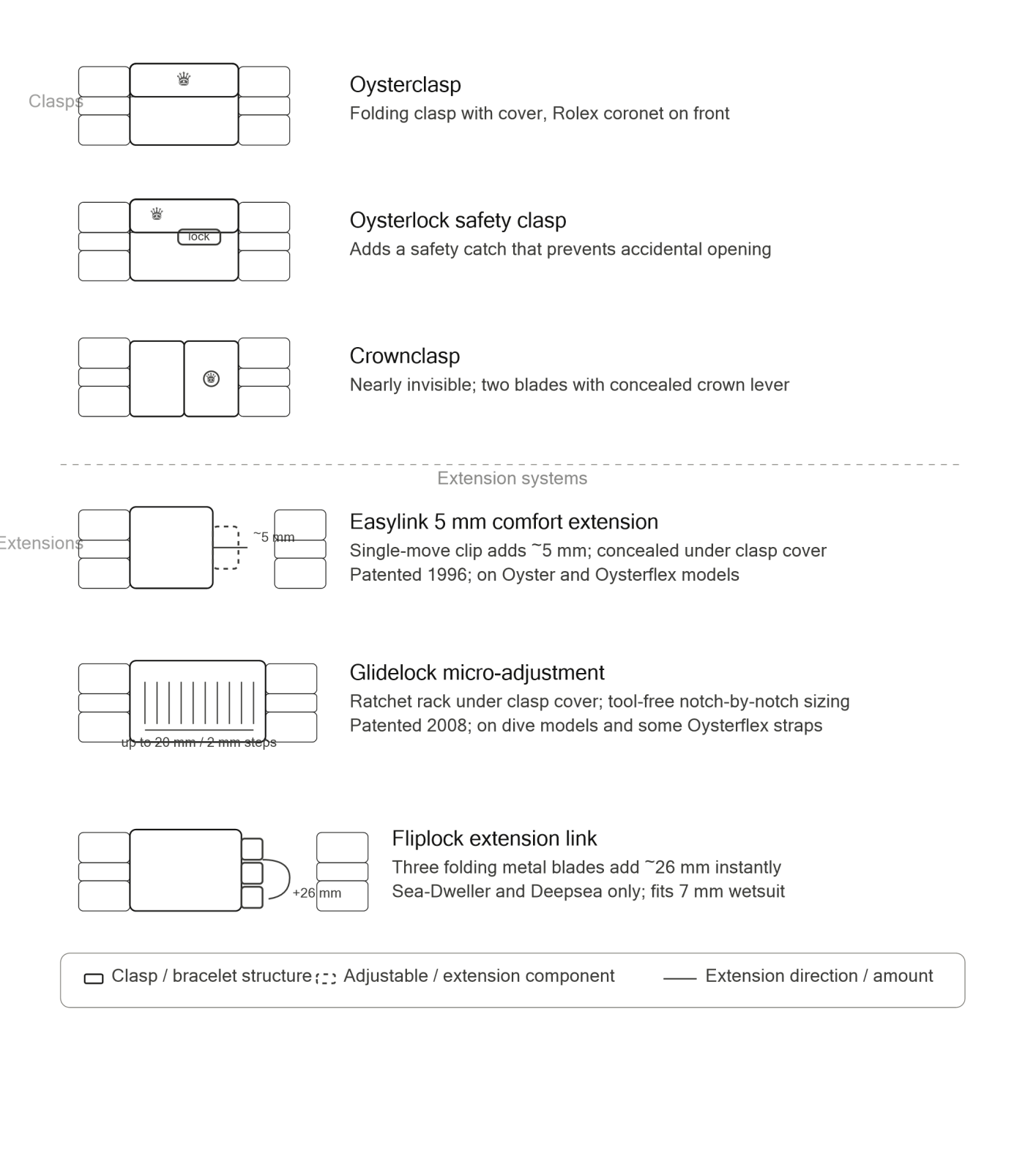
Rolex uses several clasp and bracelet extension systems across different collections. Although they may look similar at first glance, each serves a different purpose depending on the watch and how it is intended to be worn.
• Oysterclasp – A folding clasp protected by a cover. It is designed for everyday use and gives the bracelet a secure, practical closure without adding too much visual weight.
• Oysterlock safety clasp – A more secure clasp system used on Rolex Professional watches. It includes an additional safety catch to reduce the risk of the clasp opening accidentally during active use.
• Crownclasp – A concealed clasp that blends into the bracelet links, with a small Rolex crown used as the opening lever. It is usually associated with more refined bracelet styles such as President and Jubilee bracelets.
• Easylink comfort extension – A quick-adjustment system hidden under the clasp. It allows the wearer to extend or shorten the bracelet by around 5mm, which is useful when the wrist expands slightly in warmer weather or during daily activity.
• Glidelock extension system – A tool-free micro-adjustment system that allows a more precise bracelet fit. It is especially useful on diving and sport models because the bracelet can be adjusted in small increments without removing links.
• Fliplock extension link – A specialist extension system used for deep-diving Rolex models. It allows the bracelet to be extended further so the watch can be worn over a thicker diving suit.
Although Rolex bracelet styles are strongly associated with certain collections, compatibility depends on the exact reference. Some models have always been supplied with a single bracelet, while others have offered different bracelet options over time.
|
Rolex model |
Common bracelet options |
What to know before buying |
|
Rolex Submariner |
Oyster bracelet |
The Submariner is most strongly associated with the Oyster bracelet. It suits the watch’s diving heritage, offers a robust feel, and is usually paired with practical clasp features such as Glidelock on modern references. |
|
Rolex Day-Date |
President bracelet |
The President bracelet is one of the defining features of the Day-Date. Its three-piece rounded links give the watch a more prestigious, formal appearance and are a major part of the model’s identity. |
|
Rolex Yacht-Master |
Oyster or Oysterflex bracelet, depending on reference |
The Yacht-Master is available in different configurations, including metal Oyster bracelets and Oysterflex on selected precious-metal models. Oysterflex gives the watch a sportier, more contemporary feel while keeping a luxury finish. |
|
Rolex Land-Dweller |
Flat Jubilee bracelet |
The Land-Dweller introduced the Flat Jubilee bracelet, an integrated bracelet design created specifically for the model. It gives the watch a modern, seamless case-and-bracelet look. |
|
Rolex 1908 |
Leather strap or Settimo bracelet, depending on version |
The Perpetual 1908 is Rolex’s dress-focused model, so it can appear on an alligator leather strap or the seven-piece Settimo bracelet. This is important because leather straps are not only a vintage Rolex detail; they still exist in Rolex’s current dress collection. |
|
Rolex Pearlmaster |
Pearlmaster bracelet |
The Pearlmaster bracelet has rounded five-piece links and is closely associated with Rolex’s jewellery-led watches. It is more decorative and formal than the Oyster or Jubilee bracelet. |
Bracelet compatibility always depends on the exact reference, lug width, end links and originality. Before replacing or swapping a bracelet, always check compatibility for your specific watch.
In most cases, a Jubilee bracelet is not the original factory configuration for a Rolex Submariner. Some aftermarket or modified setups may physically fit certain references, but they can affect originality, serviceability and resale value.
Some collectors prefer the softer feel of the Jubilee bracelet, while others believe the Oyster bracelet better reflects the Submariner's tool-watch heritage. Although certain reference numbers can accept both bracelet styles, originality remains one of the biggest factors affecting long-term desirability.
Before buying a modified or bracelet-swapped Submariner, read our guide to buying a preowned Rolex so you know what to check before committing.
Your bracelet choice affects more than looks. It influences wear patterns, ageing, and what happens when you service or sell.
All Rolex bracelets stretch with daily wear. The question: how much and how fast?
Oyster bracelets resist stretch better because of three-piece construction. Fewer connection points mean less movement between links, helping maintain tighter fit over years.
Jubilee bracelets (five-piece links) offer more flexibility. But flexibility means more connection points and more opportunity for looseness. After several years of wear, a Jubilee typically feels looser than an Oyster in similar condition.
This isn't poor construction. It's a design choice. The flexibility making it comfortable also makes it susceptible to stretch.
Regular servicing addresses this. At The Diamond Box, we offer in-house servicing that takes a closer look at the case, movement and the bracelet. Our technicians can tighten bracelet links, restoring most original fit but if you're wearing the watch daily for years without servicing, the Oyster holds up better.
Bracelet replacement costs vary by material and style.
OEM Rolex bracelet replacements: £800 to £1,500 for steel, £2,500 to £6,000+ for precious metals. Rolex enforces "one-in, one-out" policy where you surrender your original bracelet when ordering replacement, preventing aftermarket resale. These replacements often require ordering through authorised dealers, and depending on the reference, you might encounter the Rolex waiting list for certain bracelet types.
This matters because aftermarket parts lower watch value by up to 40%. Modified Rolexes (non-original bezels, bracelets, or crowns) lose 30 to 40% resale value.
When buying pre-owned: Check if the bracelet is original. If replaced, find out if replacement came from Rolex or aftermarket supplier. This affects value and long-term serviceability.
Certain bracelet configurations command higher secondary market prices.
GMT-Master II "Pepsi" on Jubilee trades at premium over same reference on Oyster. Datejust on Jubilee generally commands higher resale than same reference on Oyster.
This isn't universal. Some buyers prefer Oyster for durability and sportier look. But generally, Jubilee is seen as more desirable on models offering both options.
President bracelet stays exclusive to Day-Date. Because it's only available in precious metals, it adds significant weight to overall cost and to replacement cost if problems arise.
Key point: Bracelet originality and condition affect resale value as much as the watch head itself. Treat the bracelet as part of the watch's long-term value, not an accessory.
Your right bracelet depends on how you'll wear the watch, what matters in daily use, and which models you're considering.
Daily wear: Oyster (durable, versatile, holds shape)
Comfort: Jubilee (flexible, drapes naturally, reduces pressure)
Luxury: President (exclusive, prestigious, precious metals only)
Modern sporty style: Oysterflex (comfort with contemporary look)
Collectors: Depends on reference and rarity (original configuration and condition matter most)
Bracelet preference changes with lifestyle and wrist size. What feels right on one person won't suit another. What works for office wear won't always work for active pursuits.
Try different bracelet styles in person before deciding. The difference between Oyster and Jubilee isn't visual. It's tactile. That matters when you're wearing the watch every day.
If you'd like to explore different Rolex bracelet types and styles or discuss which configuration suits your needs, speak with our specialists at The Diamond Box. As a reputable Rolex Dealer in London, we're able to guide you through the practical differences between bracelet types based on years of handling these watches across different references.
Yes. All Rolex bracelets stretch with daily wear. Oyster bracelets (three-piece links) resist stretch better than Jubilee bracelets (five-piece links). Regular servicing includes link tightening to restore fit.
Steel bracelets cost £800 to £1,500 for OEM replacement. Precious metal bracelets run £2,500 to £6,000+. Rolex requires you to surrender the original bracelet when ordering a replacement.
Original bracelets hold value best. Aftermarket replacements lower watch value by up to 40%. On models offering both options, Jubilee typically commands slightly higher resale than Oyster (though buyer preference varies).
Oyster uses three-piece flat-link construction (more rigid, resists stretch better). Jubilee uses five-piece links (more flexible, more comfortable, but stretches more over time). Oyster suits sports models. Jubilee suits dress-sport models.
No. Oysterflex contains internal titanium and nickel alloy metal blades covered with elastomer. This prevents stretching and deforming (common problems with rubber straps) whilst providing rubber-like comfort.
Only the Day-Date. The President bracelet is exclusive to this model and only available in precious metals (yellow gold, white gold, Everose gold, platinum).
Modern bracelets include improvements like Glidelock micro-adjustment, Easylink extensions, stronger clasps, and better corrosion resistance. These make them more practical for daily wear, though vintage bracelets remain desirable for collectors seeking original configurations.
Yes. Some models only come with specific bracelets. The President is exclusive to Day-Date. Oysterflex appears only on select Yacht-Master, Daytona, and Sky-Dweller references. Sports models typically offer Oyster, with some also offering Jubilee.
Rolex bracelets aren't accessories. They're part of the watch.
It affects how the watch feels, how it ages, and what it's worth when you sell or part-exchange it. Treating it as secondary means missing a decision with real consequences.
If you're choosing between an Oyster and a Jubilee, think about how you'll wear the watch. If you want something holding up well with daily wear and minimal servicing, the Oyster is safer. If you prioritise comfort and elegance and you're comfortable with regular maintenance, the Jubilee is worth considering.
If you're buying a Day-Date, the President bracelet is your only option, and it's central to what makes the Day-Date distinctive.
We've had these conversations hundreds of times over the years. The bracelet matters. The right choice depends on what you're looking for.
Visit us in store for great service and to see our amazing collection.
114 Ballards Lane, N3 2DN, London 020 8838 3655